
How Much Does Pet Shipping Cost from Canada? A Realistic Price Breakdown
Travelling with a cat in the cabin yourself? Our guide to flying with a cat from Canada covers the carrier rules and the security checkpoint.
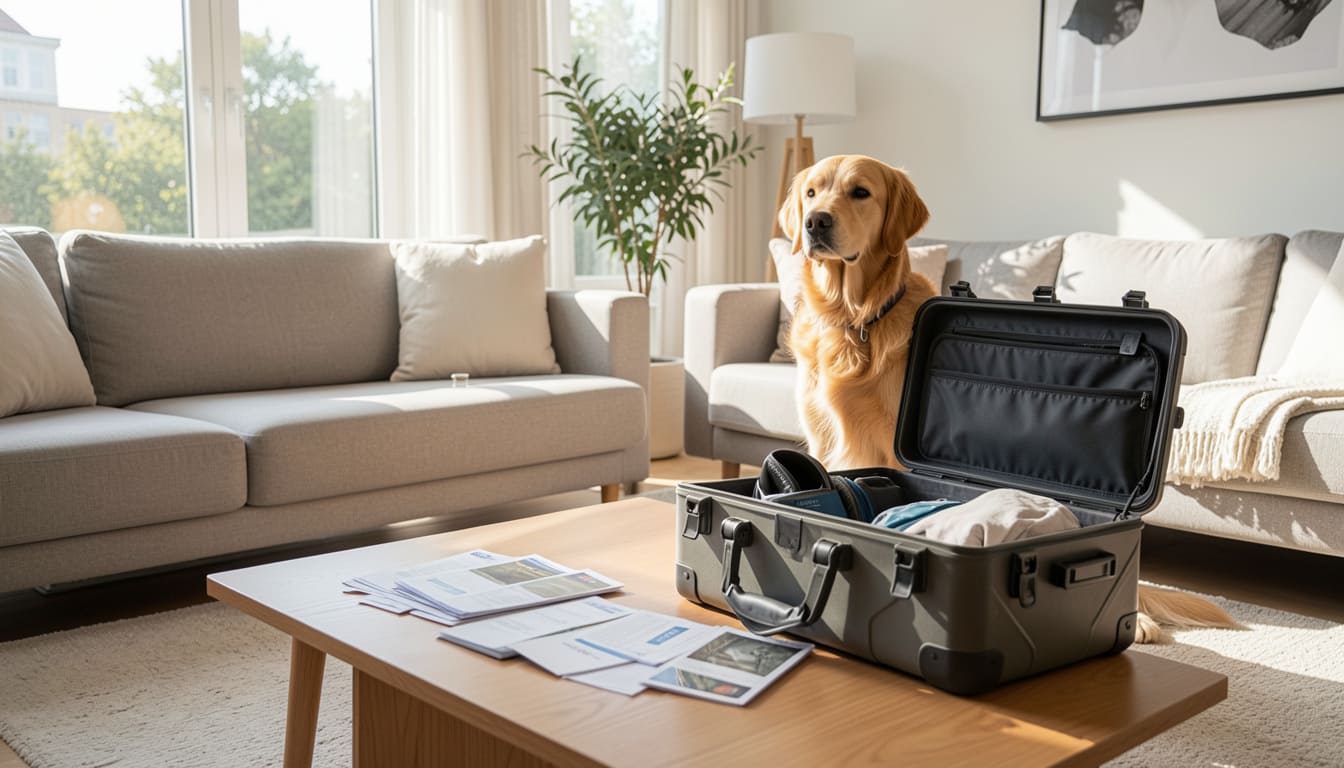
What goes into the cost of shipping a pet from Canada
If you are moving abroad or sending your pet to a new home, the price tag is probably one of your first questions. Pet shipping costs from Canada vary widely depending on where your pet is going, how big they are, and what paperwork their destination requires.
Here is a realistic look at what you can expect to spend, what drives the price up or down, and where people commonly underestimate costs. Figures checked September 2026 against published fees and carrier pricing.
Domestic pet transport within Canada
In-cabin flights
If your pet is small enough to fly in the cabin, domestic pet transport is relatively affordable. Air Canada and WestJet each charge a pet fee per direction, one price on domestic and United States flights and another on other international routes. Our WestJet pet policy guide gives that airline’s figures.
WestJet also carries pets as checked baggage, at a higher fee in each direction. Air Canada also carries pets in the baggage compartment on domestic routes at its own published rate, which our Air Canada pet policy guide sets out in full alongside the seasonal temperature bans that close that option for part of the year. You will also need a soft-sided carrier that fits under the seat.
A domestic move needs no CFIA export certificate, because nothing is leaving the country. What applies instead is provincial, and it is the part people miss: Ontario, for example, requires a dog or cat to be vaccinated against rabies from three months old and says plainly that indoor pets are included. Check the destination province before booking the vet, not after. For a cabin-sized pet the whole trip usually lands under $200 CAD each way.
Cargo flights within Canada
Larger dogs that cannot fly in-cabin travel as checked baggage or manifested cargo. Air Canada Cargo’s charges and fees page, read 15 September 2026, says to contact a local sales representative for a quote on dogs and cats travelling within North America. Its AC Animals page for dogs and cats, read the same day, says pricing is one-way only and varies based on origin, destination and dimensional weight. The charges and fees page lists two add-ons within Canada: a terminal fee of $80 CAD per shipment, and a security screening fee of $0.17 CAD per kg with a $20 minimum. You will also need an IATA-compliant crate, priced by size in our pet shipping cost calculator.
For the full decision, drive versus cabin versus cargo, plus a four week preparation countdown, see our guide on how to move your pet across Canada.
International pet shipping from Canada
Shipping to the United States
Moving a pet from Canada to the U.S. is one of the simpler international routes, but the paperwork requirements changed significantly in 2024. The CDC now requires a CDC Dog Import Form for all dogs entering the United States, regardless of origin. For a dog that has only been in Canada or another rabies-free or low-risk country in the past six months, the CDC Dog Import Form receipt is the only required documentation. Total cost for a small dog flying in-cabin: roughly $300 to $600 CAD. For a larger dog in cargo with professional coordination: $2,000 to $3,500 CAD.
See the Canada to United States breakdown for this lane, or pick another route from our pet shipping cost calculator. Canada to Australia is the most expensive route we handle, and the breakdown shows why.
Shipping to the United Kingdom
The UK requires a rabies vaccination, microchip, and a tapeworm treatment administered 24 to 120 hours before arrival. There is no quarantine for pets arriving from Canada with proper documentation, but the timing of that tapeworm treatment is strict. Miss the window and your pet cannot enter. Budget $3,500 to $5,500 CAD for full-service relocation of a medium-sized dog to the UK. Norway asks dogs for the same 24 to 120 hour tapeworm window, on its own CFIA certificate.
Shipping to Australia or New Zealand
These are among the most expensive destinations because of mandatory quarantine. Australia requires a minimum 10-day quarantine at the Mickleham Post Entry Quarantine Facility, plus a rabies titre test taken at least 180 days before travel. The process takes 6 to 8 months of preparation. Total cost: $5,000 to $10,000 CAD or more, depending on your pet’s size and the length of quarantine.
Shipping to Europe (EU countries)
A pet leaving Canada for the EU travels on an EU animal health certificate, because the European pet passport is issued only to pet owners who are resident in the EU. Pets from Canada need a microchip, rabies vaccination, and a veterinary health certificate endorsed by the Canadian Food Inspection Agency (CFIA). A rabies antibody titre test is not required for a pet travelling directly from Canada to Germany, France or elsewhere in the EU, the agency says, though a pet that travels through certain countries may need one. Budget $3,000 to $6,000 CAD for a medium-sized dog.
Shipping to Asia
Costs vary significantly across Asian destinations. Japan has a rigorous 180-day pre-travel process involving multiple rabies vaccinations and titre tests. Singapore requires an import permit and has strict breed restrictions. Budget $4,000 to $8,000 CAD for most Asian destinations.
What it costs to ship a dog from Canada
The figures above are the same for any pet, but a dog move and a cat move sit at opposite ends of them, and the reason is size. Air Canada and WestJet each publish a carrier size. Air Canada’s general limit is 40 cm wide, 43 cm long and 20 cm high, with exceptions on some aircraft, and WestJet’s is 41 cm long, 21.5 cm high and 25.4 cm wide. A dog that fits a carrier that size travels in the cabin for the same fee an airline charges for a cat. A dog too big for one travels as checked baggage or manifested cargo, and that single line moves the total from under $200 CAD to the $2,000 to $3,500 CAD range for a larger dog with full coordination. There is no gradual slope between the two.
The crate is the second cost, and it is also a constraint. A dog in the hold needs an IATA-compliant container sized so the dog can stand, turn and lie down naturally, and that container decides which aircraft can carry it. Air Canada takes a pet and kennel in its baggage compartment up to 45 kg together and 292 cm in length, width and height added up, and sends a larger kennel to Air Canada Cargo instead. Air Canada Cargo’s published station details show that Saskatoon does not offer the AC Animals product, so a pet cannot be sent from there as Air Canada cargo, and that Regina screens pets only on weekdays from 09:00 to 15:00. Driving to Toronto Pearson or Vancouver and flying from there is often the cheaper answer rather than the slower one, because it removes a connection and opens the aircraft that take larger containers. Air Canada Cargo says that, depending on the aircraft type, it cannot accommodate every kennel size, and that each aircraft has its own animal weight limits. Its published charts give a maximum package height of 83 cm on the Airbus A220 and 86 cm on the Boeing 737 MAX, among the aircraft it lists, and it asks you to contact it about accommodating your animal on the aircraft you book. The airline crate size calculator on our US site works out IATA’s minimum inside dimensions for your dog or cat’s travel crate.
Breed changes the price when it changes the route. Air Canada will not take a snub-nosed dog in its baggage compartment. A Bulldog, Pug or Boxer can end up on a longer routing with a different airline, or waiting for a season when a hold booking is possible at all. Our guide to breed restrictions on Canadian routes covers which policies apply where, and the Canadian airline pet policies guide sets out what each carrier accepts.
Winter is a Canadian cost the international guides tend to skip. Air Canada publishes its winter rules by aircraft and temperature. From 1 November to 31 March, and whenever it is 0 °C or below, it accepts no cats or dogs under 4.5 kg in the baggage compartment of any of its aircraft and advises against animals as checked baggage on its Airbus A319, A320 and A321, whose cargo compartment is not heated. From November to March its Boeing 737 MAX 8 takes no cats or dogs in the baggage compartment at all. A dog rebooked twice has picked up two sets of boarding nights and possibly a second health certificate if the first one expired waiting. Flying midday in winter and early or late in summer avoids most of it. Our guide to winter pet shipping in Canada goes through the temperature rules in detail, and the full dog transport service page covers how a move is put together.
What it costs to ship a cat from Canada
Most cats stay under the cabin limit for their whole adult life, which makes a cat move the cheapest version of this in almost every case. Within Canada, that is the airline cabin fee each way plus a soft carrier, and a total that usually stays under $200 CAD once a health certificate is included. On a Canada to United States flight the cabin fee is unchanged and the paperwork is light for cats, since the CDC dog import form does not apply to them.
Moving two cats is not simply double, and it is not the same as one cat either. Air Canada allows one cat or small dog in the cabin per passenger, and WestJet one pet per guest. A second cat needs a second passenger travelling with it or a separate booking on the same flight. Whether two cats can share a container in the hold depends on the airline, the destination and the cats themselves, and we confirm it for the specific route rather than assuming it.
The expensive cat moves are not expensive because of the cat. They are expensive because of where the cat is going. Australia and New Zealand require a rabies titre test with a waiting period measured in months, and that calendar governs the whole move: the flight can be booked late but the blood draw cannot. A cat leaving Canada for one of those destinations needs its testing sequence started long before anyone looks at fares, and the route breakdowns in the cost calculator show which lanes carry that constraint.
One practical point that costs owners money more often than any fee. Both limit how many animals travel in the cabin on each flight. WestJet says space for pets can be reserved online or by phone, and Air Canada asks you to register a pet with its Reservations line. Either way, add the pet as soon as you have booked your own seat. Leave it and the flight fills, and the alternatives are a different date or the hold, which is a different price bracket entirely. The cat transport service page covers the rest of the process.
What is included in full-service pet relocation
The service fee covers:
- Route planning and airline booking (cargo or excess baggage)
- CFIA health certificate and endorsement coordination
- IATA-compliant crate sizing, assembly and labelling
- Import permit applications where required
- Airport delivery, airline check-in, and monitoring
- Destination-side customs clearance coordination
- Door-to-door tracking and updates
Factors that increase cost
Several factors can push your pet’s shipping cost higher than the ranges above:
Pet size is the biggest variable. A 5 kg cat in-cabin is a fraction of the cost of a 40 kg dog flying cargo. Larger crates mean higher airline fees and more complex logistics.
Destination requirements matter. Countries with quarantine (Australia, New Zealand, Hawaii) add facility fees and extended boarding. Countries requiring titre tests add about USD $79 to $90 in lab fees, plus your vet’s charge for the blood draw, courier to a US laboratory and the months of advance planning. Japan’s and the European Union’s lists of designated laboratories, both read 28 September 2026, name none in Canada.
Seasonal restrictions can force route changes. Winter cold embargoes in Canada and summer heat embargoes at destination airports can limit which days and routes are available, sometimes requiring ground transport segments that add cost.
Brachycephalic breeds (bulldogs, pugs, Persian cats) face airline restrictions that limit route options. The viable routes that remain may be more expensive.
How to get an accurate quote
Before you compare totals, ask each company to draw one line through its quote. Above it goes the money it passes on to others for you: the airline for freight, CFIA for any export endorsement, the destination’s own government charges, your clinic for the exam and certificate, and the crate. Below it goes the company’s charge for the work it does itself: the planning and timing that hold the move together. Other people set the prices above the line. Air Canada Cargo’s AC Animals page for dogs and cats, read 15 September 2026, is an example: it says its pricing varies based on origin, destination and dimensional weight. The price below the line belongs to the company alone. Kept apart, the halves let you set one quote against another fairly. Merged into one number, a lower total could come from either half, and the quote gives you no way to tell which.

Each entry above the line should name what it assumes:
- Freight, naming the dates, the route and the crate’s dimensions.
- Cabin, checked baggage or cargo, settled in writing.
- The CFIA endorsement, on a line apart from your clinic’s exam and certificate.
- Destination charges where the country sets them, such as an import permit, quarantine or laboratory tests.
- A crate bought through the company, shown on its own line.
- Any road leg, including a drive to a larger airport.
To check the government lines, find your lane in our pet shipping cost calculator, which sets out the fees for each Canadian route it covers.
Ready to start planning your pet’s move?
Request a quote and we will put together a detailed plan and price for your specific route.
Prefer to talk? Give us a call at 1-877-707-1739.
Want this as a printable list? Our free two page checklist covers every step in order, from the first vet visit to travel day, with space for your own notes.
Frequently asked questions
Is it cheaper to ship a pet from Canada than from the United States?
It depends on the destination. Airline cargo rates from Canadian airports (Toronto Pearson, Vancouver International, Montreal Trudeau) are comparable to major U.S. hubs. The CFIA endorsement fee is often lower than the USDA fee. However, fewer direct cargo routes from Canada to some destinations can mean a connection, which adds cost.
Can I claim pet shipping costs on my taxes?
If you are relocating for work and your employer is not covering the cost, pet shipping may be deductible as a moving expense in some provinces. Consult a tax professional for your specific situation, as CRA rules on eligible moving expenses are detailed.
Do I pay in Canadian or U.S. dollars?
This varies by provider. Airline cargo fees are typically charged in the currency of the departure country. Our quotes are in Canadian dollars for Canadian departures, so there are no exchange-rate surprises.
What is the cheapest way to ship a pet internationally?
Flying in-cabin with your pet is the least expensive option if your pet qualifies by size. For larger pets, booking as excess baggage on your own flight is typically cheaper than manifested cargo. The trade-off is that you handle all the logistics, paperwork timing, and airport coordination yourself.
Sources
Checked September 2026.
- CFIA, pets (dogs, cats and ferrets): export certificates. Most pets need an export certificate from a licensed vet, endorsed by an official CFIA veterinarian before the animal leaves Canada. Requirements are listed country by country.
- Air Canada, travelling with your pet. Cabin and baggage compartment rules, advance registration, the brachycephalic restriction, and the soft-sided carrier rule introduced on 1 June 2025.
- WestJet, pets. WestJet own rules for pets in the cabin and in the hold, and the entrance requirements it expects guests to meet.
Airline charges are one of the few figures you can pin down before anything else. Our Air Canada pet policy guide has the full fee table.
Last updated