
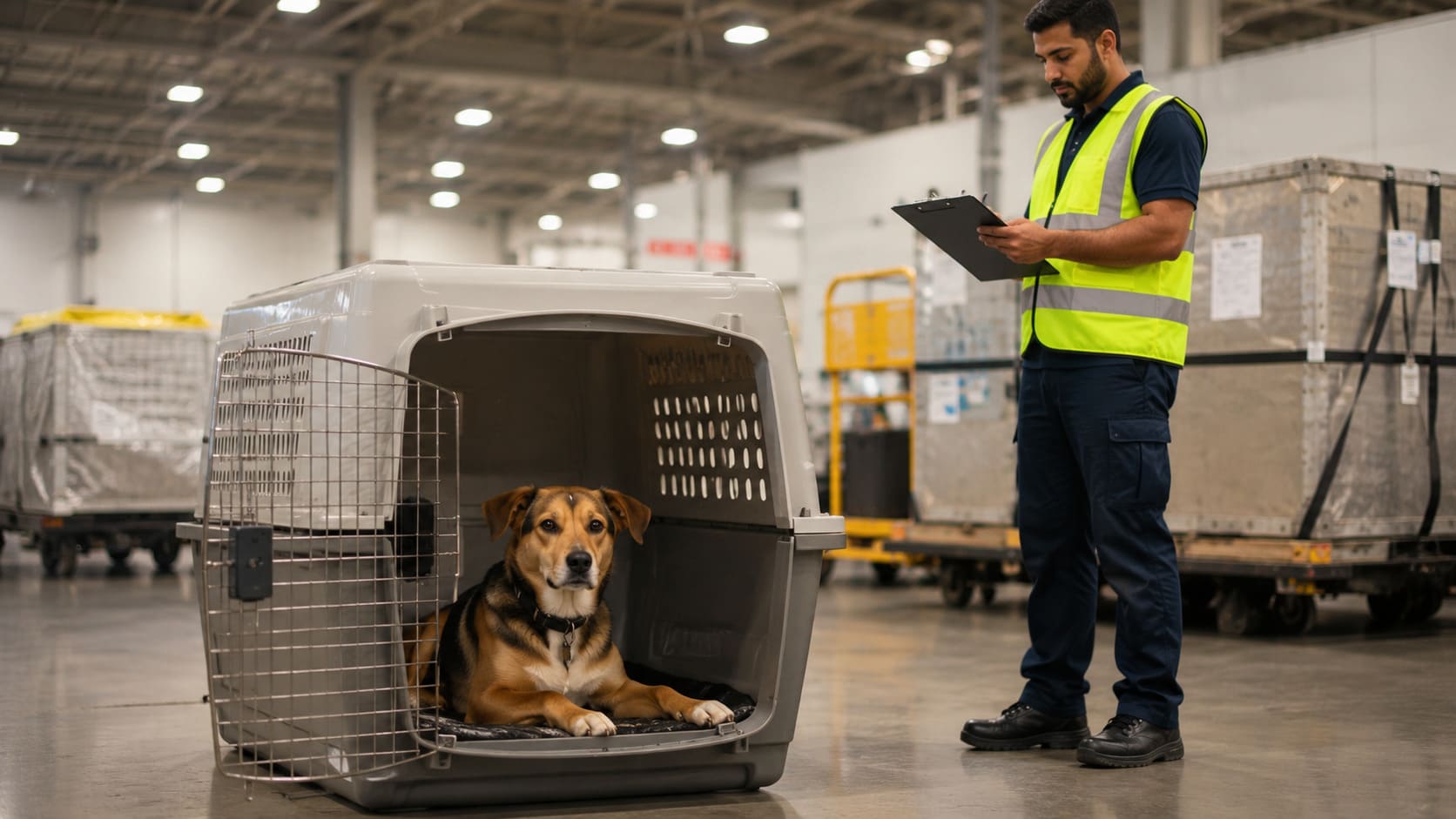
International Pet Shipping from Canada
Pet Travel Advisors is an international pet shipping service. We relocate dogs, cats, birds and small exotic pets from Canada to destinations across Europe, Asia, the Pacific, the Middle East, Africa, Latin America and the United States, door to door. That covers collection from your home, the import permit, any rabies titre testing, the destination health certificate and its CFIA endorsement, an IATA crate, the airline booking out of a Canadian gateway, customs clearance on arrival and delivery to the new address.
Moving a pet out of Canada is a paperwork problem before it is a flight problem. The destination country decides what your pet needs and how long the preparation takes, the CFIA certifies the documents at this end, and the flight is the last thing booked rather than the first. We handle the whole sequence, from the first eligibility check to the handover on arrival.
Where We Ship Pets
We move dogs, cats, birds and small exotic pets from Canada to destinations across Europe, Asia, the Pacific, the Middle East, Africa, Latin America and the United States. Some routes are straightforward and take a few weeks. Others sit behind a rabies-free import regime that puts the whole move on a calendar measured in months. The first thing we tell you is which of the two you are dealing with, because everything else follows from it.
Europe and the UK
Microchip, rabies vaccination and the destination health certificate endorsed by the CFIA, with a short pre-travel window. Most routes are achievable in weeks.
Asia and the Pacific
Requirements range from straightforward to among the strictest anywhere. Japan, Australia and New Zealand run long testing calendars that govern the whole move.
The Americas, Middle East and Africa
Import permits are common and processing times vary widely. Several destinations need an approved agent in place before an air waybill can be issued.
The Destination Sets the Rules, Not the Airline
Owners usually start by comparing airlines, which is the wrong end of the problem. The destination country publishes its entry requirements, and those requirements decide which carriers can be used at all: some do not accept live animals into certain countries, some accept them only as manifested cargo, and some need an approved agent at the destination before an air waybill can be issued.
So the sequence runs the other way. We read the destination rules first, work out what your pet needs and when, and only then look at which airlines serve that route out of a Canadian gateway with live animal acceptance on workable dates. A cheap fare on a carrier that cannot take your dog into that country is not a cheap fare.
The CFIA Export Certificate, and What It Is Not
Canada does not issue a single international pet passport. What it issues is an export certificate: your own veterinarian completes the destination country form, and the Canadian Food Inspection Agency then endorses it.
The fee is trivial and the timing is not. CFIA endorsement runs through regional offices by appointment, and the appointment has to fall inside the destination window, which is commonly ten days before arrival. That leaves a narrow slot between the veterinary examination and the flight, and it is the single most common place a Canadian export gets delayed. We book the CFIA appointment against the flight rather than against the move date.
Rabies Titre Testing, and the Calendar It Creates
A rabies titre test, sometimes written as a FAVN or RNATT, measures the antibody level in your pet blood to confirm the rabies vaccination worked. It is not a vaccination and it is not a formality. Where a country requires one, your veterinarian draws the blood, an approved laboratory processes it, and the result starts a waiting period before the animal may enter.
That waiting period is the largest variable in an international move. It runs three months for many destinations and considerably longer for the rabies-free island countries. If the sample is drawn late, or the first result comes back below the threshold and has to be repeated, the whole move slides by the length of the wait. Canada has relatively few approved laboratories for some destination regimes, so samples often travel further than owners expect, which adds days at exactly the wrong point.
The Crate Decides Which Aircraft Can Carry Your Pet
A pet travelling in the hold needs an IATA-compliant container: rigid, ventilated on the required number of sides, closed with metal hardware rather than plastic clips, and sized so the animal can stand fully upright, turn around and lie down naturally. Undersizing is the most common reason a pet is refused at the counter, and check-in is a bad time to find out.
The crate also decides the aircraft. Air Canada Cargo says that, depending on the aircraft type, it cannot accommodate every kennel size, and that each aircraft has its own animal weight limits. Its published charts give a maximum package height of 83 cm on the Airbus A220 and 86 cm on the Boeing 737 MAX, among the aircraft it lists, and it asks you to contact it about accommodating your animal on the aircraft you book. This matters more in Canada than it does further south, because most long-haul departures leave from a small number of airports and the feeder legs into them are flown by exactly the aircraft a large crate will not fit.
Cabin, Checked Baggage or Manifested Cargo
Three modes and three different price brackets. In the cabin means a small pet under the seat, which very few carriers permit on long-haul routes into strict destinations. Air Canada and WestJet each publish a carrier size. Air Canada’s general limit is 40 cm wide, 43 cm long and 20 cm high, with exceptions on some aircraft, and WestJet’s is 41 cm long, 21.5 cm high and 25.4 cm wide. Checked baggage means the pet flies in the hold on the owner booking, which is simpler but which several carriers have restricted.
Manifested cargo means the pet travels as a separate shipment on its own air waybill. It is the mode most international moves out of Canada actually use, it is the only mode some destinations accept, and it is the mode where an agent works each end, tendering the shipment to the airline at origin and clearing the animal through customs on arrival. It is also the mode that gives the animal the most attention, because cargo staff at the major gateways handle live animals daily and check-in happens at a dedicated counter rather than a passenger desk.
Flying Out of a Canadian Gateway
Most international pet departures from Canada go through Toronto Pearson, Vancouver, Montréal-Trudeau or Calgary, because those are the airports with the long-haul aircraft, the live animal cargo facilities and the staff who deal with animals every day.
If you are not near one of them, the road leg to the gateway is usually the cheaper answer rather than the slower one. Air Canada Cargo’s published station details show that Saskatoon does not offer the AC Animals product, so a pet cannot be sent from there as Air Canada cargo, and that Regina screens pets only on weekdays from 09:00 to 15:00. Air Canada takes a pet and kennel in its baggage compartment up to 45 kg together and 292 cm in length, width and height added up, and sends a larger kennel to Air Canada Cargo instead. A road leg also avoids the situation where the feeder flight accepts the pet and the crate does not fit the aircraft flying it.
Winter and Summer Both Close Routes
Canada gives you cold-weather limits at one end of the year and heat limits at the other.
Summer heat limits are the ones people know about. Airlines refuse pets in the hold when ground temperatures at any point on the itinerary sit above the safe band, which affects the destination and the connecting airports as much as the departure. Air Canada publishes its winter rules by aircraft and temperature. From 1 November to 31 March, and whenever it is 0 °C or below, it accepts no cats or dogs under 4.5 kg in the baggage compartment of any of its aircraft and advises against animals as checked baggage on its Airbus A319, A320 and A321, whose cargo compartment is not heated. From November to March its Boeing 737 MAX 8 takes no cats or dogs in the baggage compartment at all. Air Canada Cargo says that from 1 November to 31 March it does not accept warm-blooded animals as cargo on some of its narrowbody fleet, because their cargo holds are not heated.
Planning around both is straightforward once you know they exist. Fly midday in winter and early or late in summer, keep the routing as direct as possible so there are fewer airports where a temperature reading can stop the trip, and build a spare week into the schedule on the routes where a cold snap is likely.
Country Requirements, Route by Route
Every destination we serve has its own page, with the entry requirements, the documents, the timeline and the fees set out in full rather than summarized. Start at the international pet shipping destinations index and pick the country you are moving to.
For the cost side, the pet shipping cost calculator carries a route-by-route breakdown. For species-specific detail, see dog transport and cat transport.
How an International Move Works
Five stages, and the first one is the one that saves money.
1. Eligibility Check
We confirm the destination rules for your species and breed, and whether the date you need is achievable at all.
2. Testing and Paperwork
Vaccinations, any titre test, the import permit, the health certificate and the CFIA endorsement appointment, sequenced so nothing expires.
3. Crate and Preparation
Correct IATA container sized and sourced, with time for your pet to get used to it before travel day.
4. Flight and Handling
Routing chosen for live animal acceptance and aircraft type, with check-in at the cargo counter and monitoring in transit.
5. Clearance and Delivery
Customs clearance at the destination, inspection or quarantine handled, and delivery to the address you give us.
We stay with the move from the eligibility check to the handover.
What It Costs
We do not publish a single figure for an international move out of Canada, and the reason is honest rather than evasive: air freight from Canada is quoted per booking rather than off a published tariff, so any number we printed would be a guess dressed up as a price. What we can publish is the parts.
Our pet shipping cost calculator gives the retail price of an IATA container by size. Veterinary fees for the examination, vaccinations and any required tests are set by your own clinic, and a laboratory titre test is set by the lab. Airline freight is the variable, priced on the chargeable weight of pet and crate together, which is why we size the crate before we quote. For a specific route, ask us and we will get you a real number rather than a range.
Tell Us About Your Move
Tell us the destination, the species and breed, the approximate weight, and when you need to be there. We will tell you whether the timeline is achievable, what the testing calendar looks like, and what the move costs, before you commit to anything.
GET A PET RELOCATION QUOTE:

Frequently asked questions
How far in advance should I start an international pet move from Canada?
For most European destinations, six to eight weeks is comfortable. For Japan, Australia, New Zealand and the other rabies-free destinations, start six to nine months ahead, because the rabies titre waiting period cannot be shortened for any reason. If you are not sure which category your destination falls into, ask us before booking anything else.
What does the CFIA actually do in the process?
Your veterinarian completes the destination country certificate, and the CFIA endorses it, which is what makes it valid for export. The endorsement is done by appointment through a regional office, and because the destination window is usually about ten days, that appointment has to be timed against the flight rather than booked early.
Can my pet fly in the cabin on an international flight from Canada?
Sometimes, and less often than owners expect. It depends on the airline, the aircraft, the route and the destination. Several strict destinations require animals to arrive as manifested cargo regardless of size, which rules the cabin out entirely. We check the specific route rather than assuming, because the answer changes by carrier and by season.
Does my pet have to go into quarantine?
It depends entirely on the destination. Most of Europe and most of the Americas release pets at the airport with no quarantine when the paperwork is right. Australia and New Zealand require a stay at a quarantine facility, booked and paid for in advance. Japan releases without quarantine only if the full testing schedule was completed correctly.
Do I have to fly from Toronto or Vancouver?
Not necessarily, but most long-haul pet departures from Canada do leave from Toronto Pearson, Vancouver, Montréal-Trudeau or Calgary. If you are somewhere else, we will price both options, and a road leg to a gateway is often cheaper overall because it removes a connection and opens the aircraft types that take larger crates.
What credentials does your team hold?
Our team holds IATA Live Animals Regulations certificates. Our documentation follows Canadian Food Inspection Agency requirements for export from Canada and the entry requirements published by each destination country.